
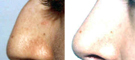

































History of Rhinoplasty: The ancient Egyptians are said to have practiced facial reconstructive surgery as early as 3,000 B.C. and in ancient India, an ayurvedic physician Sushruta, described a technique for reconstructing an amputated nose using a skin flap technique. In the late sixteenth century, an Italian surgeon named Gasparo Tagliacozzi described a procedure in which he attached part of the bicep muscle to the patient’s face, left his arm attached to his nose for 5 weeks, and then staged a second surgery to separate the two, in which he shaped the grafted skin into a nose.
In 1887, an American otolaryngologist, John Orlando Roe, performed the first closed rhinoplasty in modern history. He wasn’t merely reconstructing a missing nose—he was correcting a deformity (saddle nose deformity, in this instance). Two years later, Jacques Joseph, considered by many to be the father of modern facial plastic surgery, performed rhinoplasty or nose sjob surgery on a 28 year-old man whose extremely large nose caused him such embarrassment that he couldn’t bear to appear in public. By the late 19th Century, doctors in both Europe and America were discovering the value of plastic surgery for aesthetic improvement as well as the impact these improvements could have on a patient’s life.
The science of cosmetic rhinoplasty was further advanced by the technological innovations that followed World War I and World War II. With a vast number of veterans requiring reconstructive procedures for wounds and traumatic injuries, doctors were spurred to refine and improve existing procedures. One of the more dramatic improvements was in the field of anesthesia. The availability of safer, more reliable anesthesia made elective plastic surgery and cosmetic surgery procedures far more popular.
By the 1950s in the history of rhinoplasty, it was not uncommon for the wealthy and powerful to avail themselves of plastic surgery. Hollywood stars including Marilyn Monroe, Clark Cable, Gary Cooper, John Wayne, and Rita Hayworth all had cosmetic surgery. Carrie Fisher told London’s Daily Mail that her mother, Debbie Reynolds, was pressured by her studio to have a rhinoplasty procedure, even though the results of these early procedures were notoriously unreliable. “My mother was made to have her ears pinned back,” says Fisher, “but she refused the nose job because they were really butchering them then.”
Rhinoplasty or nose job surgery has clearly evolved since its early days. The history of rhinoplasty is long! Cosmetic plastic surgery techniques have been highly refined and surgical instruments have become technologically advanced. And from its days as a privilege for the rich and powerful, rhinoplasty has become a reliable, popular means of improvement for people of all means.
To determine if you might benefit from rhinoplasty or nose job surgery, call Dr. Yagoda today to schedule your personal comprehensive plastic surgery consultation in her New York, NY office.