



























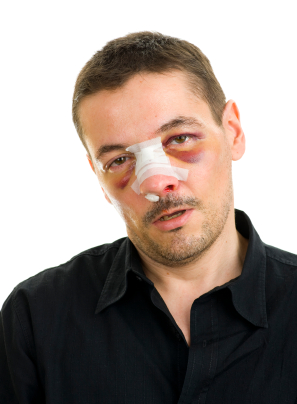
There is a Japanese proverb that says, “The nail that sticks up will get hammered down.” As the most prominent facial feature, it should come as no surprise that the nose is the third most commonly broken bone in the body and the most commonly broken bone on the face. Prominence has its price.
While nose fractures and trauma are common, they’re not always easy to fix. Because the nose is packed with complex and delicate structures—septum, turbinates, sinuses, bone, tissue, and cartilage—nasal trauma can have a serious and lasting impact on both the function and appearance of your nose. If you get hit in the face and it doesn’t look like you broke your nose, you should still see an otolaryngologist (an ear, nose, and throat physician). Even if your nosebleed stops and you’re not sure if you’ve broken anything, you might have a septal hematoma (collection of blood in the septum), which, if not treated properly, could lead to septal perforation or nasal collapse, which are more difficult to treat. If not treated properly, long-term complications can be very difficult to resolve.
Sometimes nasal trauma is a result of domestic abuse. The American Academy of Facial Plastic and Reconstructive Surgery has a program that provides survivors of domestic abuse with a network of safe environments. For those survivors looking to erase the physical and emotional reminders of their abuse, Dr. Yagoda is a facial plastic surgeon in New York, NYC, and Manhattan who provides complimentary plastic surgery through Face-to-Face: the Domestic Violence Project.
If you’ve suffered nasal trauma, it’s imperative that you consult an otolaryngologist and ideally, someone like Dr. Yagoda who is also a facial plastic surgeon, for comprehensive care. Come to her New York/NYC/Manhattan office for a cosmetic surgery consultation, and she can address correct and restore the function and appearance of a nose damaged or broken by traumatic injury, and to eliminate reminders of that trauma.
Read about Dr. Yagoda’s Integrative Post Operative Care Program
Flying In
Dr. Yagoda’s patients come to New York City, NYC, and Manhattan from all over the world. From Qatar to Quebec, we can help you get here from abroad.